
Etsy SEO Guide: How To Do SEO of Etsy Listings?

I know the frustration of listing a beautiful handmade product and watching it sit with zero views for weeks on Etsy. I’ve been selling on Etsy for the last 9 years, and that silence only broke when I mastered how to do SEO of Etsy listings.
In this Etsy SEO guide, I will share the exact strategies I use to keep my Etsy shop and listings at the top of the search results. No matter if you are listing your first item on Etsy or looking to scale a full-time business, your success depends on how well you understand the Etsy algorithm.
Over the nearly a decade I’ve spent on Etsy, I’ve found that your listing title is where you need to put most of your SEO effort. I always place my most important keywords at the very beginning of the title because the first 40 characters are what mobile Etsy shoppers see first.
I also learned that using all 13 tags with long-tail phrases is the secret to appearing in relevant, high-intent searches on Etsy. In 2026, Etsy’s algorithm now looks for natural, conversational language rather than a jumbled mess of repeating keywords.
Follow along as I break down the simple steps to SEO optimize your Etsy listings and turn those quiet days into a stream of sales notifications. Ready to see your products finally land on the first page of Etsy?
Does SEO Work on Etsy?
I have spent years watching Etsy sellers struggle, and I can tell you that SEO is the only reason some Etsy shops thrive while others vanish.
Search engine optimization is not just a tech buzzword; it is the heartbeat of your entire Etsy business.
I look at Etsy SEO as a two-part machine that starts with a computer but ends with a human.
First, you must prove to the Etsy search bar that your listing is the exact answer to a shopper’s specific question.
If I list a “Coffee Mug,” I am competing with millions, but if I list a “Handmade Ceramic Ghost Mug,” I suddenly have a target.
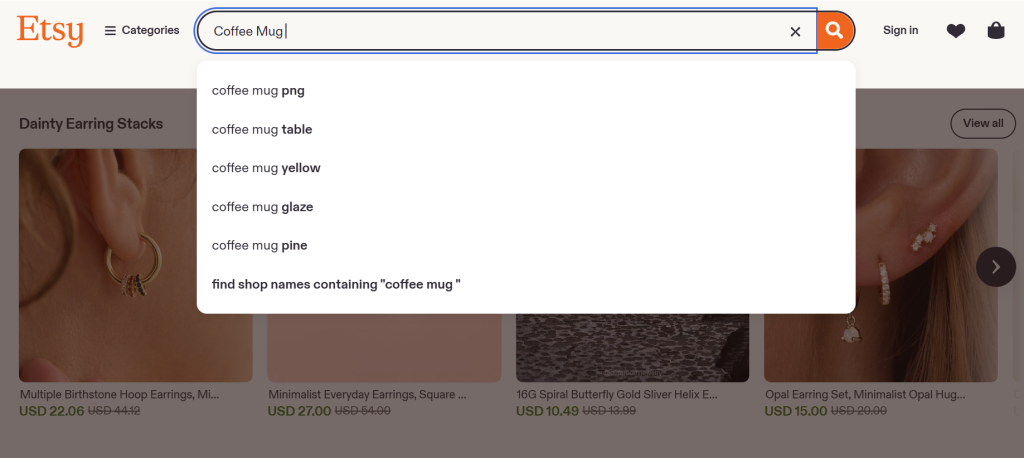
I use titles, tags, and attributes to act as a map that guides the Etsy algorithm straight to my shop.
In 2026, the game has shifted toward natural language, so I write my titles like I am talking to a friend.
I put my most important words in the first forty characters because that is all a mobile shopper sees before they scroll past.
Once the Etsy algorithm finds me, the second part of SEO kicks in: the click-through rate.
If a thousand people see my listing but nobody clicks, Etsy decides my item is not relevant and buries it.
I focus on my main photo more than anything else because a blurry or boring image will kill even the best keyword strategy.
Shipping prices also play a massive role now, as Etsy lowers the rank of any item with high domestic delivery costs.
I have found that offering free shipping or keeping the cost under six dollars is a hidden “SEO boost” that most sellers ignore.
When my listing finally gets a click, the goal shifts to conversion, or turning that visitor into a paying customer.
Etsy tracks how many people actually buy my item, and the more I sell, the higher the Etsy algorithm pushes me in the rankings.
This creates a “momentum” effect where my best-selling items stay at the top of the Etsy search results for months.
I never just set my keywords and walk away; I treat my Etsy shop like a garden that needs constant weeding and fresh seeds.
Successful SEO on Etsy is about matching the right words with a great experience that makes people want to hit the “Buy” button.
Is Etsy SEO Different from Google SEO?

Yes, they are different because they serve two different “bosses.”
Etsy SEO is about intent and conversion within a closed marketplace. The Etsy algorithm cares most about whether a shopper who types a specific phrase actually hits the “Buy” button on your item.
It relies heavily on your 13 tags, specific attributes (like color or occasion), and your Listing Quality Score, which tracks clicks and sales. In 2026, Etsy also prioritizes logistics, like keeping shipping costs under $6.
Google SEO is about authority and information across the entire web. Google’s algorithm looks at your listing descriptions and shop “About” section to understand the context.
It values “backlinks” (other websites linking to you) and how well you answer a broad search query.
While Etsy SEO thrives on short, catchy titles for mobile shoppers, Google SEO prefers descriptive, keyword-rich sentences that help it categorize your page among billions of others.
How Does Etsy SEO Work?
I treat Etsy SEO as a smart conversation between my Etsy shop and the marketplace algorithm.
While keywords tell the Etsy algorithm what I am selling, the real magic happens behind the scenes through a process called “Query Matching.”
In 2026, the Etsy algorithm does not just look for exact words; it uses “Natural Language Processing” to understand the meaning behind a buyer’s search.
If a buyer types in “comfy office vibes,” the Etsy algorithm is smart enough to show my desk mats and soft lighting even if I never used those exact words.
I make sure to fill out every single “Attribute” like color, material, and occasion because Etsy uses these as extra invisible tags to categorize my listings.
Once I qualify for a search, the algorithm moves into the “Ranking” phase to decide exactly where my listing sits on the page.
If I have a history of five-star reviews and ship my orders on time, the algorithm trusts me more and gives my listings an organic boost.
I also pay close attention to “Personalization,” which means Etsy shows different results to different people based on their past clicks.
If a shopper loves “Boho” style, the algorithm will prioritize my bohemian listings for them while showing “Minimalist” options to someone else.
I keep my Etsy shop’s “About” section and “Policies” fully completed because it makes my Etsy shop look more relevant to both buyers and Etsy’s search engine.
What Are Etsy SEO Keywords?
I look at Etsy SEO keywords as the specific “secret codes” that bridge the gap between what I’m selling and what a buyer is typing into their phone.
These are the descriptive words and phrases I strategically place in my listing to tell the Etsy search engine exactly who my item is for.
In 2026, the best SEO keywords on Etsy are no longer just single words like “jewelry” or “decor,” which are too broad to help me stand out.
I focus on “Long-Tail Keywords,” which are three-to-four-word phrases like “emerald green statement earrings” or “personalized wooden nursery name sign.”

These phrases are powerful because they have less competition and attract shoppers who are ready to buy exactly what I have.
I think of my keywords in three different layers: what the item is, who it is for, and when they would use it.
I might use “hand-poured soy candle” to describe the product, “gift for new homeowners” to target a buyer, and “hygge home decor” to capture a specific vibe.
The Etsy algorithm scans my title and my thirteen tags to find these matches, so I make sure my most important SEO keywords appear in both places.
How Long Does It Take for Etsy SEO to Kick In?
I’ve learned the hard way that Etsy SEO is not an instant “on” switch.
When I update an Etsy listing’s keywords or tags, the change technically happens within minutes, but the ranking results take much longer.
I typically wait at least four to six weeks before I decide if a change was a success or a failure.
The Etsy algorithm needs this time to test my “new” listing against shoppers to see if they actually click and buy.
If I change my tags every few days, I never give the Etsy algorithm enough data to learn where I belong, which keeps my Etsy shop buried.
I give my Etsy listings about 21 days of organic data before I even consider touching them again.
Patience is a skill here; I let the data settle so the Etsy algorithm can find my perfect buying audience.
Is ChatGPT Good for Etsy SEO?
I’ve found that ChatGPT is an incredible teammate for Etsy SEO, but it is a terrible “autopilot.”
In 2026, the Etsy algorithm has evolved to favor natural language and human-like descriptions, which means simply copying and pasting AI text can actually hurt your Etsy rankings.
I use ChatGPT as a high-speed brainstorming partner to generate dozens of long-tail keyword ideas in seconds.
It is brilliant at taking a basic phrase like “blue bowl” and turning it into “handmade cobalt blue ceramic bowl,” which is exactly the kind of specific detail the Etsy algorithm loves.

However, I never let it write my final titles without a human touch because AI tends to “keyword stuff,” and Etsy now penalizes titles that look like a jumbled list of words.
I also use ChatGPT to analyze my customer reviews to find the exact words real people use to describe my products, which I then turn into tags.
The real danger is “generic content”; if your description sounds like every other AI-generated shop, shoppers will lose trust and bounce, which lowers your conversion rate and kills your SEO.
I treat ChatGPT like a research assistant: I let it find the patterns, but I always write the final version to make sure it sounds like me.
How To Do SEO of My Etsy Listings?
Master the Art of Long-Tail Keywords
Most Etsy sellers use broad terms like “necklace” or “painting.” I avoid these because the competition is too high for a small Etsy shop to win.
Instead, I focus on long-tail keywords, which are descriptive phrases with three or more words. Think “boho gold layering necklace” or “abstract blue nursery wall art.”
These specific phrases have less competition. More importantly, people searching for specific items are much more likely to hit that “buy” button right away.
Now that you have your perfect phrases, you need to know exactly where to put them for maximum impact.
Front-Load Your Listing Titles
The first few words of your Etsy listing’s title carry the most weight with Etsy’s search engine. I put my most important keyword at the very beginning.
I make sure the title reads naturally for humans while still hitting those search terms. Avoid using all caps or strange symbols that make your listing look unprofessional.
Etsy buyers often skim titles on mobile devices. If they see exactly what they want in the first four words, they are going to click your listing.
Once your title is set, your tags need to work behind the scenes to support those main keywords.
Use All 13 Etsy Tags Strategically
Etsy gives you 13 tags for a reason, and I never let a single one go to waste. I treat each tag as a fresh chance to get found.
I don’t repeat words if I can help it. If “leather wallet” is in my title, I use tags for “anniversary gift,” “mens accessories,” or “minimalist gear.”
Think about the occasion, the recipient, or the style. This variation helps my items show up in “gift for him” searches even if that’s not in the title.
Etsy tags are great for search, but your attributes are the secret “filters” that help shoppers narrow down their choices.
Maximize Your Listing Attributes
Attributes are the extra details like color, material, or room type. Many Etsy sellers skip these, but I fill out every single one that applies.
These act like free extra tags. When a buyer filters their search by “Green” or “Silk,” your item won’t show up unless you’ve checked those boxes.
By being thorough here, I ensure my listings appear in filtered searches. This often places me in front of a much smaller, highly interested group of buyers.
Great keywords get you the click, but the next step is what keeps you at the top of the search results over time.
Focus on Your Listing Quality Score
Etsy tracks how people interact with your listings. If many people click your item but nobody buys it, Etsy stops showing it to others.
I keep my “Listing Quality Score” high by using great item photos and clear descriptions. Great images prove to the buyer that the item is worth their money.
When my conversion rate goes up, Etsy rewards me with a higher search rank. The algorithm also sees my shop as a “winner,” which makes customers happy.
While internal SEO is important, bringing in outside traffic gives your shop a massive “authority” boost in Etsy’s eyes.
Build Backlinks and Social Proof
I don’t just wait for Etsy to find me. I share my listings on Pinterest and blogs to create “backlinks” that point toward my shop.
Etsy loves it when you bring “outside” buyers to its marketplace. They often reward this by giving your listings a temporary boost in their internal search results.
I also encourage reviews by providing good customer service and fast shipping. Positive reviews from Etsy buyers signal to the search engine that my shop is trustworthy and deserves a top spot.
What Are Common Etsy SEO Mistakes?
Using “Keyword Stuffing” in Titles
In the past, Etsy sellers would cram every possible word into a title like “Gift for Her, Gift for Mom, Birthday Gift, Jewelry.” Today, Etsy actually penalizes this behavior.
The Etsy algorithm now prefers natural, “human-sounding” language. If your title looks like a list of random words, it confuses buyers and lowers your search rankings on Etsy.
I now focus on writing one clear, descriptive phrase that explains exactly what the item is. I save the extra “gift” ideas for my tags instead of cluttering the title.
Writing for humans first makes your Etsy listings captivating. Once you’ve fixed your titles, you need to make sure you aren’t fighting against your own listings.
Falling into “Keyword Cannibalization”
I used to think that using the same best-performing keyword for all 50 of my listings was a smart move. In reality, I was making my own listings compete against each other.
Etsy rarely shows more than one or two items from the same Etsy shop for a single search term. If all your items use the same tags, you are essentially hiding your own listings.
I solve this by giving each listing a unique “angle.” One might focus on the “boho style,” while another focuses on the “anniversary gift” aspect.
Diversifying your keywords allows you to cast a much wider net. However, even the best keywords won’t save you if your shipping costs are too high.
Ignoring the New “Shipping Price” Factor
As of early 2026, Etsy has started lowering the search rank for items with high domestic shipping prices. Specifically, shipping over $6 can now “tank” your visibility in US search results.
Etsy wants to compete with big retailers by offering low or free shipping. If your shipping is expensive, the algorithm assumes buyers will abandon their carts.
I try to bake some of the shipping cost into the item price itself. This allows me to offer “Free Shipping,” which gives my listings a massive natural boost in the search results.
While shipping affects your rank, forgetting to fill out the “boring” parts of a listing can also hold you back.
Leaving Attributes and Categories Blank
Many Etsy sellers think that if they have good tags, they don’t need to worry about the dropdown menus for color, size, or material. This is a huge missed opportunity.
Attributes act like extra “hidden” tags that don’t count toward your limit of 13. When buyers use the sidebar filters to find “Blue” items, your listing won’t show up if you left that attribute blank.
I treat every attribute field as a mandatory step. It takes an extra 30 seconds but ensures my listings appear in those highly specific, filtered searches.
Attributes help people find you, but the quality of your photos is what determines if they stay.
Neglecting Shop Policies and the “About” Page
Etsy’s algorithm doesn’t just look at your listings; it looks at the whole shop. If you haven’t filled out your returns policy or your “About” section, you might be seen as less “trustworthy.”
Etsy shops with completed profiles and clear policies often get a slight edge in search rankings. It shows Etsy and the buyer that you are a serious Etsy seller.
I made sure to upload a shop banner and write a short story about how I make my items. This simple step helped my Etsy shop feel “complete” and boosted my overall authority in Etsy search results.



Leave a Reply